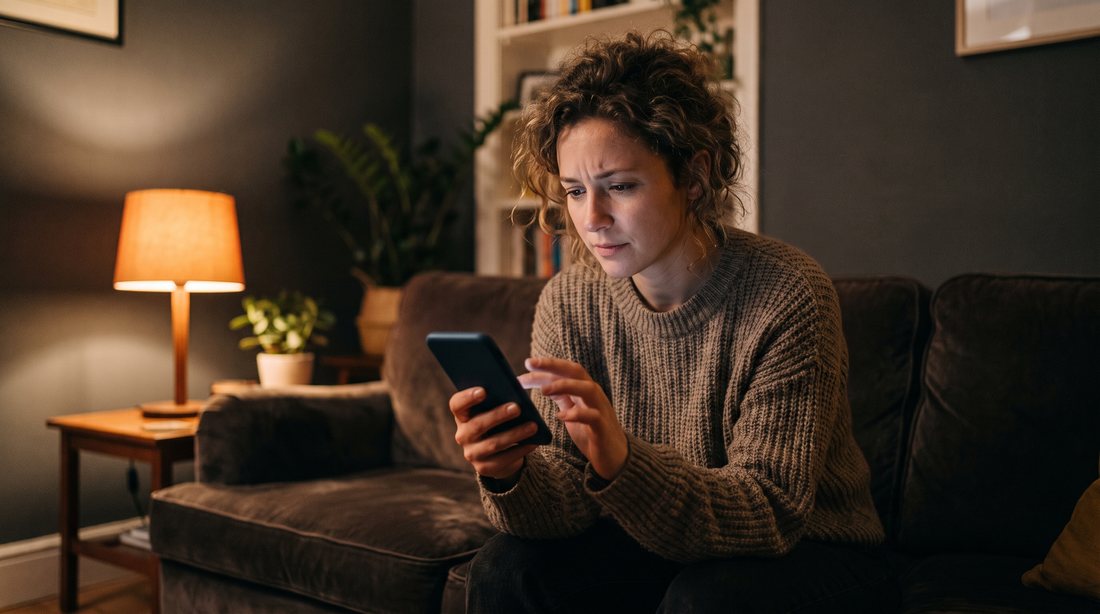
The last thing you bought online, how long was it between seeing it and owning it? For a lot of people the honest answer is under a minute. That's not an accident, and figuring out how to stop impulse buying online starts with accepting that you're up against something that was deliberately engineered.
Every pause that used to exist has been removed on purpose. You no longer type a card number. You don't leave the house. You don't even see a total until the thing is already on its way. The gap between wanting and buying used to be where you changed your mind, and that gap is now about four seconds wide.
Why impulse buying online is a design problem, not a willpower one
People beat themselves up about this, which is both unfair and useless. Shops spend enormous amounts of money on exactly this behaviour. Saved payment details, one-tap checkout, free returns that make the decision feel reversible, a countdown on the stock number, a feed that has watched what you linger on for years. You are not losing to your own character. You're losing to a team of people whose job it was to make you lose.
It also doesn't feel like spending. Tapping a phone in bed is a completely different physical act from handing over cash in a shop, and your brain treats it that way. The money leaves later, from an account you're not looking at, and the parcel arrives days afterwards when the urge that caused it has long gone.
So the fix isn't to try harder. It's to put a small amount of friction back into the two or three places where the decision actually happens.
Make yourself type the card number again
This is the single most effective change, and almost nobody does it because it's mildly annoying. That's precisely why it works.
- Remove your saved cards from the shops you spend most in. Not your bank, not your phone wallet, just the retailer accounts. Having to fetch a physical card adds maybe forty seconds, which is long enough for the wanting to fade.
- Turn off one-tap or express checkout wherever it's offered. The whole product is the removal of a decision point. Put the decision point back.
- Log out of shopping apps rather than just closing them. A password prompt is a surprisingly good speed bump at 11pm.
- Delete the two or three apps you open out of boredom. Keep the websites. Browsing a site in a mobile browser is just slightly worse than an app, and slightly worse is the whole point.
None of this stops you buying anything. If you genuinely want the thing on Tuesday, you'll still want it on Tuesday and you'll go and get your card. It only stops the purchases that needed speed to survive.

Use a waiting rule instead of a ban
Flat bans don't hold. You'll keep one for nine days and then buy something expensive out of spite. A delay rule holds much better, because nothing is forbidden, it's just postponed.
Pick a threshold that means something to you, maybe $30 or $50, and a waiting period, usually two days for small things and a week for larger ones. Anything over the threshold goes on a list with the date and the price. When the waiting period is up, you buy it or you don't.
Keep the list, including the things you decided against. It becomes the most persuasive document you own, because a want you've written down and then quietly stopped caring about is much harder to argue with than a vague feeling that you probably overspend.
A ban is a promise you make to a version of yourself who isn't tired yet. A two-day wait is a promise anyone can keep.
The other half of the rule is about triggers. Impulse buying clusters around specific states: late at night, immediately after work, when you're bored on a commute, and right after something has gone badly. Notice which one is yours. If every unwanted purchase you've made this year happened after 10pm, the answer isn't more discipline during the day.
See the money leave, in the moment it leaves
Here's the part most advice skips. All of the above works far better if you can actually feel the spending as it happens, and bank apps are genuinely bad at giving you that.
Card payments take a day or two to settle, so the balance you check tonight is describing a version of your week that's already out of date. Online orders are worse, because the merchant name on the statement is often some payments company you've never heard of, so a week later you're squinting at a list trying to remember what you bought. By then it's archaeology, not budgeting.
Logging the purchase yourself, at the moment you make it, changes the act. It's a tiny deliberate pause where you write down what you just did, which is about as far from one-tap checkout as you can get. Plenty of people find that the logging alone kills a fair share of their impulse purchases, because having to record something makes you briefly account for it.
Bud is built around that moment. Adding an expense takes about seven seconds, and on iPhone you can map it to the Action Button so it's one press rather than a hunt through your home screen. There's no bank login involved, ever, so nothing is waiting on a settlement delay. Buddy, the assistant inside the app, will answer the question directly: ask what you've spent on shopping this month and you get a number, not a chart to decode.
Bud is free to download. Bud Plus is $1.99 a month or $15.99 a year if you want the extras, and the habit described in this post works fine without paying for anything.
What to do about the stuff you already bought
Two things, and the first one has a deadline.
Return it. Not every impulse buy is final. Go and look at what arrived in the last two weeks and still has its tags on. Free returns were designed to lower your resistance at checkout, so you may as well use them in the other direction. Put the return window in your calendar the day something arrives, because the usual reason people keep things they don't want is that the window quietly closed.
Then count it. Add up what you've spent on non-essential online orders over the last three months. One number, no categories, no judgement. Guess first, then count, and pay attention to the gap between the two. That gap is the most useful piece of information in this whole exercise, and it's usually wider than anyone expects.
How long before it sticks
Give it about a month. The first week is irritating, mostly because you'll reach for a saved card that isn't there any more and feel briefly indignant about it. Somewhere in the second week the waiting list starts doing the work on its own, and you'll notice you've stopped adding things to it as often.
The goal was never to stop buying things online. It's to make the decision happen before the checkout page rather than after the parcel arrives. Put forty seconds back between the want and the purchase and most of this problem solves itself, which is a slightly deflating conclusion for something that feels as personal as overspending.
Track your money in seconds, not spreadsheets.
Bud is free to download, built for iPhone, and never asks for a bank login.
