
Cash is the money your budgeting app quietly pretends does not exist. You pull a twenty out of an ATM, your bank records one neat withdrawal, and then that twenty scatters into a coffee, a tip, a birthday card, and the parking meter, none of which ever shows up anywhere. So at the end of the month the app tells you that you spent less than you actually did. It is a comforting little lie, and it holds right up until your balance disagrees with it.
If you use notes and coins for even part of your week, this is probably the single biggest hole in your budget. Not because cash is hard to track, but because the tools most people rely on were built to watch a bank feed, and cash is the one thing a bank feed cannot follow. Closing that gap is worth it, and it is a lot easier than it sounds once you stop expecting the automation to do it for you.
Why cash is the blind spot in every automatic tracker
Apps that link to your bank work by reading transactions. That is genuinely useful for card payments, where the merchant name and amount come through on their own. Cash breaks the whole model. The moment you withdraw money, the trail ends. Your app sees a single line that says something like "ATM £40" and has no idea whether that became groceries, a haircut, or three rounds at the pub.
Most tools just dump the whole withdrawal into a category called "Cash" or "ATM" and move on. Technically the money is accounted for, but you have learned nothing. A budget is supposed to show you where your money goes, and "it went to cash" is exactly the answer you already knew. The insight you actually wanted, that you spend forty quid a week on lunches you barely remember, is precisely the part that got swallowed.
The only real fix is logging it as it leaves your hand
Here is the uncomfortable bit. There is no clever automation that recovers cash spending after the fact, because the data was never captured anywhere. The only reliable way to track it is to record each cash purchase at the moment it happens, while you still know what it was and how much it cost.
People hate hearing this because it sounds like homework. It usually fails for the same reason. You tell yourself you will remember the £6 sandwich and write it down tonight, and by tonight it has blurred into the rest of the day. Miss a few of those and your cash log is full of guesses, and a log full of guesses feels pointless, so you drop it. The failure was never laziness. It was the gap between spending the money and recording it.
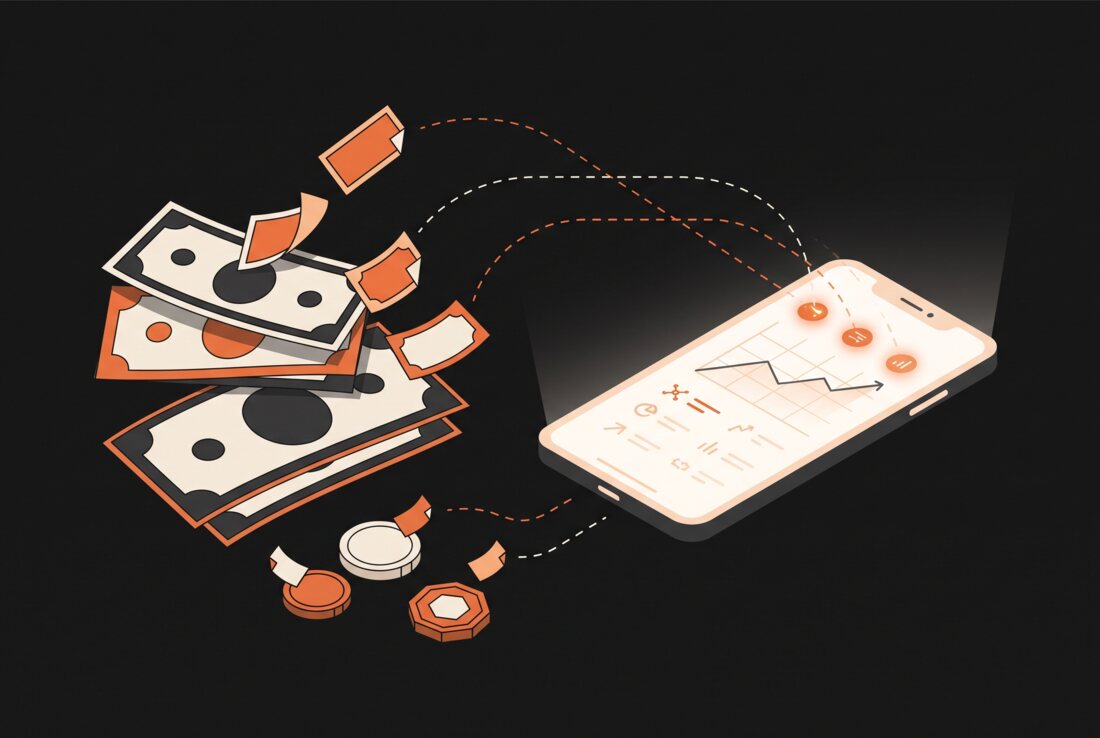
Make logging take seconds, or you won't keep doing it
The whole thing lives or dies on how long it takes to record one purchase. If logging a £3 coffee means opening an app, tapping through a couple of menus, and picking a category, you will manage it for about a week. Get it down to a few seconds, right there at the counter, and it quietly becomes automatic. This is a friction problem, and friction is the one thing you can actually engineer away.
It is the reason I built Bud the way I did. Logging one expense takes about seven seconds, and you can fire it straight from the iPhone Action Button without opening the app first. You hand over the cash, press the button, type the amount, and you are done before your change is back in your pocket. Buddy, the built-in assistant, sorts it into the right category afterward, so the tedious filing part is not on you either. You capture the number in the moment and get on with your day.
You cannot automate cash tracking. You can only make the manual version so fast that it stops feeling manual.
Round numbers are fine, missing entries are not
A lot of people quit cash tracking because they try to be too precise. They decide that if they cannot log every purchase to the exact penny, the record is worthless, so a couple of forgotten tips sink the whole effort. That is backwards. Guessing that a coffee was £3 when it was £2.80 costs you almost nothing over a month. Skipping the entry entirely costs you the pattern.
So give yourself permission to round and to estimate when you have to. If you genuinely forgot to log a £5 lunch, add a rough £5 the moment you remember rather than deciding the day is ruined. The value of tracking cash is the shape it reveals over weeks, and that shape survives small errors easily. What it does not survive is a log with holes in it, because holes are where you start telling yourself the whole thing is inaccurate anyway.
If you have tried to track cash before and given up, do not start by budgeting harder. Start by shrinking the logging to a few seconds and forgiving yourself for rounding. Get the habit to hold for a month, and the spending patterns will show up on their own.
A quiet bonus if you actually prefer cash
Plenty of people use cash on purpose. It makes spending feel real, it stops a night out from ballooning, and it keeps a lot of small purchases off any company's radar. If that is you, an app that demands your bank login just to function is a strange trade, because you were using cash partly to keep your spending private in the first place.
Bud never asks for a bank login, and your data stays on your device with optional iCloud backup if you want it. So you can track your cash carefully without handing your full transaction history to anyone. The app is free to download, and there is a Bud Plus upgrade at $1.99 a month or $15.99 a year if you want the extras, but the core logging that makes cash trackable does not cost anything.
A simple system that survives a real week
Put together, the whole method is short. Log each cash purchase the second it happens, using the fastest tool you can find so the habit does not depend on willpower. Round when you need to and never let a missed entry talk you into quitting. Then once a week, take a quick look at where the cash actually went and notice the one thing that surprises you. That weekly glance is the entire review, and it is usually the moment the invisible spending finally becomes visible.
Cash does not have to be the part of your budget you shrug at. It only feels untrackable because most apps gave up on it and taught you to do the same. Catch it at the counter instead of from memory, keep the logging tiny, and the twenty that used to vanish turns into something you can actually see. It is a small habit, and it closes the biggest blind spot most budgets have.
Track your money in seconds, not spreadsheets.
Bud is free to download, built for iPhone, and never asks for a bank login.
