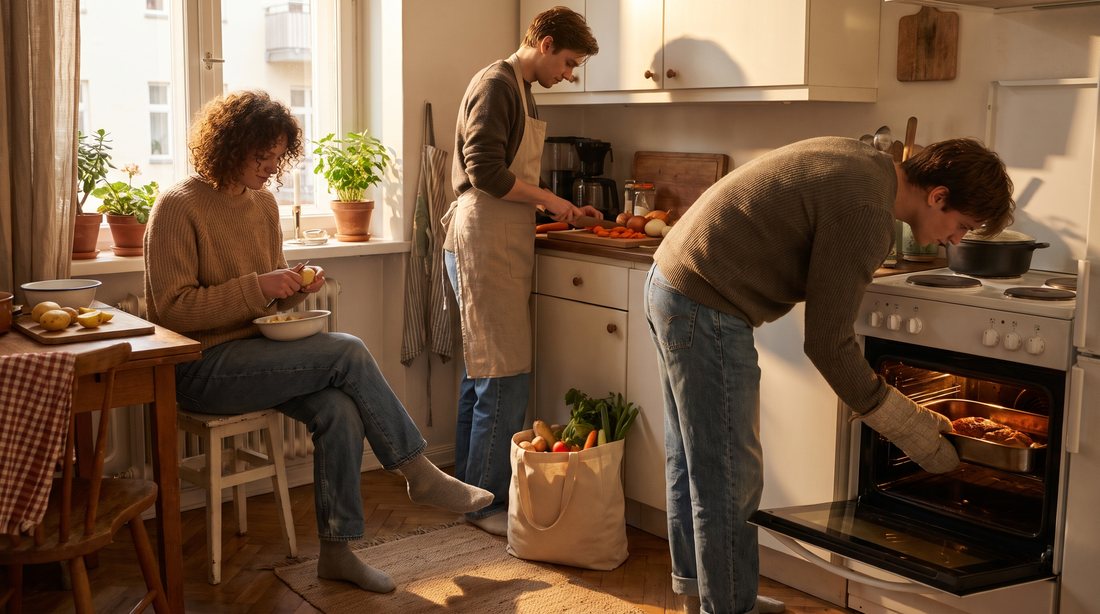
To split Friendsgiving costs, pick one method before you send the invite: a potluck where each dish counts as that person's share, an even split of the host's receipts, or a mix of the two.
Updated November 2, 2026.
What does a Friendsgiving actually cost?
A grocery basket and a hosted dinner are different bills. The American Farm Bureau Federation puts its latest classic dinner for 10 at $55.18, or about $5.52 a person. That figure is the bird, the sides, and the pantry staples. It is not wine, decorations, or the ice you forgot.
Hosting runs higher once drinks and the apartment are in the total. LendingTree found potential hosts expect to spend an average of $487 on food, drinks, and decor, and 63% expect guests to contribute money or bring an item. That is a full Thanksgiving, not a student potluck, and it is why the method has to be chosen before anyone shops. The 2026 Farm Bureau survey was not out on this updated date, so the dinner figure above is the latest published release.
How do you split Friendsgiving costs before anyone shops?
Three methods cover almost every student apartment. Pick one, write it in the invite, and do not mix them after the cart is full.
Potluck
You pay. Your dish is your share. You buy it yourself.
When. Before you arrive. There is no group bill.
Best when. People like to cook, and someone still caps the turkey.
Even split
You pay. One person shops. Divide the receipts by who eats.
When. The day the groceries are bought.
Best when. One kitchen is cooking the meal.
Hybrid
You pay. The host buys the main. Guests bring sides or chip in for the bird.
When. Turkey money goes out before the shop.
Best when. You want a turkey without one person funding it.
A potluck fails when everyone brings a cheap side and one roommate still buys the turkey. Give that dish a cap, or have the table chip in for it. That is the hybrid. An even split fails when you announce it after dinner. Say it before the first RSVP.
How much should each person pay?
Use your receipt, not a national average. These three examples use round numbers so you can check the division yourself.
- Even split. The host spends $240 on food for 8 people. $240 divided by 8 is $30. Each person sends $30.
- Drinks on the side. Food is $200 for those same 8 people, which is $25 each. Drinks are $48, split by 6 drinkers, which is $8 each. Drinkers pay $25 plus $8, so $33. Anyone who did not drink pays $25.
- Hybrid turkey. The host buys a $60 bird and 10 guests bring sides. $60 divided by 10 is $6. Each guest sends $6 for the main and still brings their dish.
If the rent week is already tight, the dinner has to fit the money you have, which is the point of a student budget. Cut a dish before you raise the per-person number in secret.
What should the invite say?
The number belongs in the invite, not in a text after people have said yes. Copy this and change the day:
Friendsgiving is at our place Saturday at 4. We are splitting the grocery receipts evenly, about $30 a person for food. Drinks are only for people who drink, so bring your own or wait for that separate total. I will send the exact amount the day I shop. Reply if you are in, and say if you do not eat turkey or if you are bringing a kid.
How do you ask people to pay?
Send it the day you shop, while the receipt is still in your pocket. Venmo, Zelle, and Cash App all work. Waiting until people are full is how a $30 share becomes a debt. If that already happened, tracking money people owe you is the longer fix. For this dinner, use a request they can pay from the couch:
Food was $200 for 8 people, so your food share is $25. Drinks were $48 for 6 people, so drinkers add $8 and send $33. If you did not drink, send $25. Venmo, Zelle, or Cash App today.
Round up to the next dollar if the receipt is messy. Say that you rounded. A house where paychecks land on different days all year needs a split that follows income. One dinner only needs a date: "I can send $33 on Friday."
What about non-drinkers, kids, and people who cancel?
Non-drinkers
Alcohol is its own total. A case of beer can cost as much as the sides, and the friend on sparkling water should not fund it. Soda everyone drank can stay on the food bill. In the example above, that is $25 for food and $8 more only if they drank.
Kids
A kid who eats a small plate is a half share of the food, not of the drinks. If the adult food share is $30, the kid is $15. A teenager who eats like an adult is a full share. Say which one you are using so a parent is not surprised.
Cancellations
If someone cancels before you shop, drop them from the count and buy less. If they cancel after you shop, the food is already paid for. Either they still owe their food share, or the table splits it. $240 for 8 people is $30. If one person drops and does not pay, $240 divided by 7 is $34.29. Put that rule in the invite. A no-show does not owe a share of drinks they never opened.
How do you track a Friendsgiving split in Bud?
Bud is an iPhone budgeting and bill-splitting app with no bank login.
Name the grocery run, type the amount, and save. That takes about seven seconds, and on iPhone you can start the entry from the Action Button without hunting for the app. Then split it equally, by a percentage, or with a custom share for the person who only stayed for pie, or for a kid on a half plate. Balances stay visible, so you are not rebuilding the night from a camera roll.
If the apartment already keeps a tab in Splitwise, Bud can import that history in about 30 seconds. Bud and Splitwise is the longer comparison. For one dinner, you need the receipt, the headcount, and a request sent the same day.
Log the shop when you leave the store, not after people go home. The split is a few taps on a number you already have.
What else do people ask about splitting Friendsgiving costs?
How do you split Friendsgiving costs?
Pick one method before you send the invite: a potluck where each dish is that person's share, an even split of the host's receipts, or a mix of the two. Put the amount in the invite, split drinks only among people who drink, and send payment requests the day you shop.
How much should each person pay for Friendsgiving?
Divide the shared receipts by the number of people who ate. If the host spends $240 on food for 8 people, each share is $30.
Should non-drinkers pay for alcohol?
No. Split food across everyone who ate, and split alcohol across the people who drank. If food is $200 for 8 people and drinks are $48 for 6 drinkers, non-drinkers pay $25 and drinkers pay $33.
What if a kid comes, or someone cancels?
A kid who eats a small plate can be a half share of the food, not of the drinks. If an adult food share is $30, that kid is $15. If someone cancels after you shop and does not pay, $240 split by the remaining 7 people is $34.29 each. Say that rule in the invite.
What is Bud?
Bud is an iPhone budgeting and bill-splitting app with no bank login. You name an expense, type the amount, and save it, then split that expense with the people who shared the meal.
Track your money in seconds, not spreadsheets.
Bud is free to download, built for iPhone, and never asks for a bank login.
